
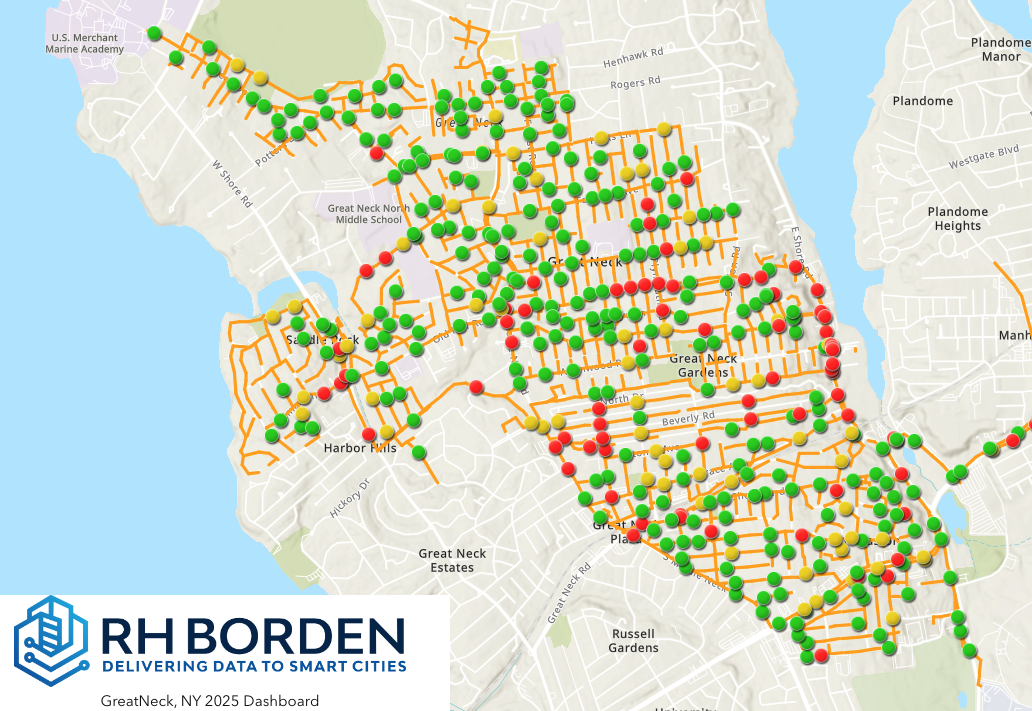
RH Borden BASINiQ finds I&I down to the exact pipe across 70 miles using 423 Sensors for Village of Great Neck, NY
Background
The Village of Great Neck, New York, faced significant challenges with inflow and infiltration (I&I) in its wastewater collection system. Excess stormwater and groundwater were entering the system through open caps, surface inflow, structural degradation, and illegal connections. These conditions increased treatment costs, strained system capacity, and posed environmental risks.
For a typical wastewater treatment plant, I&I of this scale can add an estimated $5.4 million per year in unnecessary treatment expenses. Traditional methods such as smoke testing, CCTV inspection, and manhole-by-manhole assessment are labor-intensive, often requiring five to ten years to identify only 20– 25% of problem locations.
To address these challenges more efficiently, the Village partnered with RH Borden to implement the BASINiQ™ assessment platform, which integrates dense sensor monitoring, digital manhole scans, and weather-integrated analysis.
Project at a Glance
- System Size: ~70 miles of collection system
- Duration: June – September 2025 (4 months)
- Deployment: 423 radar-based level sensors installed across the system
- Major Rain Events Captured: July 15, July 31, August 14, September 7
- Data Tools: Hydrographs + high-resolution weather integration, interactive
GIS dashboard, Manhole Virtual Models (MVMs)
Findings
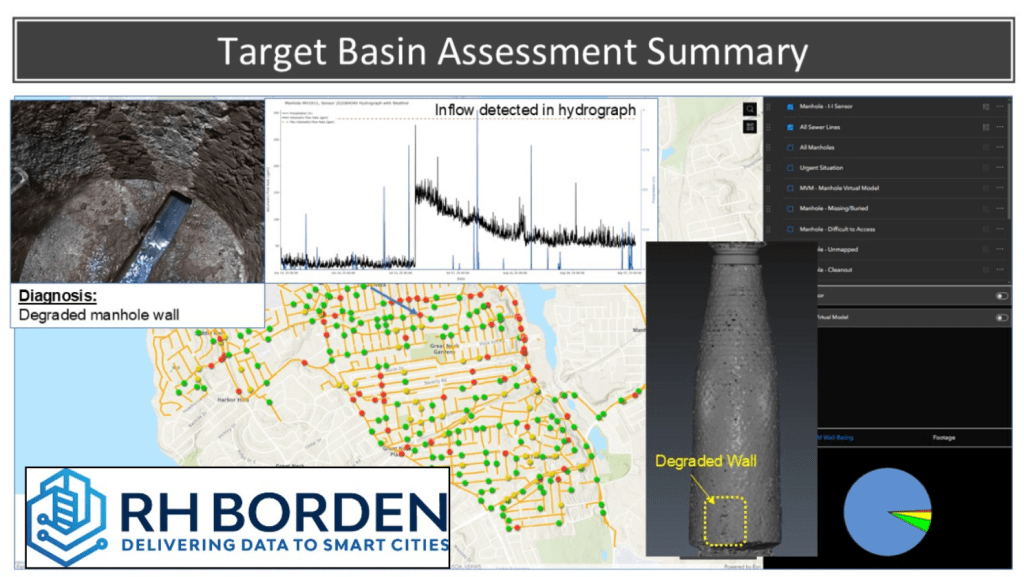
During four major storm events, BASINiQ captured real-time data that revealed patterns in the water flow at each manhole:
- Inflow: Abrupt spikes in hydrographs indicated stormwater entering through open risers, manhole defects,
and surface-level connections. - Infiltration: Slow, lingering flow increases confirmed groundwater intrusion through degraded joints, cracks,
and root intrusions. - Blockages: Erratic disruptions highlighted locations with partial obstructions or debris.
By September 2025, BASINiQ had identified 74 specific locations of I&I based on the BASINiQ flow calculations. Each location was documented with flow data, GIS mapping, and digital imagery, enabling targeted remediation actions such as fixing cleanout caps, inspecting and repairing pipes, rehabbing manholes, and repairing defects.
Results and Benefits
- Speed: Majority of I&I sources located in 4 months, compared to 5–10 years with traditional methods.
- Cost Efficiency: Assessment completed at less than half the cost of traditional approaches.
- Accuracy: Instead of general problem areas, the study produced specific, verifiable repair targets.
- Decision Support: The GIS dashboard and digital twins provide an ongoing resource for monitoring, prioritization, and validation of rehabilitation effectiveness.
- Sensor-Dense Monitoring: 423 radar-based sensors deployed every 300-800 feet using BASINiQ algorithms to calculate flow in each manhole.
- Manhole Virtual Models (MVMs): High-resolution 3D scans and 360° imagery created digital twins of manholes, identifying structural defects and inflow pathways not visible during conventional inspections.
- Weather-Integrated Flow Analysis: Hydrographs were correlated with localized rainfall data to distinguish inflow from infiltration, blockages, and normal flow variation.
Conclusion
The BASINiQ study provided the Village of Great Neck with a detailed, data-driven understanding of its collection system. The integration of dense sensor data, high-resolution manhole models, and weather correlation enabled precise identification of inflow and infiltration sources.
Compared to traditional methods, BASINiQ delivered faster results, greater accuracy, and significantly lower cost, equipping Great Neck with actionable intelligence to reduce treatment expenses and improve infrastructure resilience.
Contact us to schedule a call to discuss your I&I issues and how RH Borden BASINiQ can help to solve and identify Inflow and Infiltration in your system!