

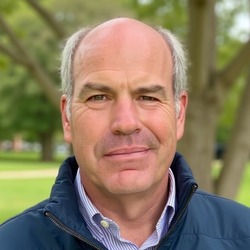
Kwin Peterson is Senior Account Manager at RH Borden and Company, a Salt Lake City-based firm applying advanced sensor technology and data-driven solutions to modernize wastewater and sewer systems across the US. He has supported more than 60 collection systems in becoming more efficient through condition-based maintenance and innovative assessment tools. Kwin also serves on the San Francisco Bay Section Collection Systems Committee. Before joining RH Borden, he spent 17 years in the electric utilities industry working in education, public relations, and technical committee support.



Here’s a glimpse of what you’ll learn:
- [1:57] Kwin Peterson’s unconventional career path from theater and electric utilities to wastewater technology
- [6:02] Why aging sewer infrastructure remains invisible — and dangerously underfunded
- [8:20] Using data to quantify hidden wastewater costs and influence city council decisions
- [11:03] How the pandemic, workforce shortages, and shrinking budgets have strained municipal sewer systems
- [13:22] Leveraging smart sewer technology to reduce operational costs by up to 89%
- [17:18] How data-driven results win over skeptical city councils
- [21:13] Why sewer systems are one of the most important public health innovations people never think about
- [25:04] A real-world success story showing how data helped a city move from crisis response to control
In this episode…
Across the US, aging wastewater systems are failing quietly beneath cities, draining budgets and increasing public health risks without clear visibility or accountability. Municipal leaders often lack the data needed to prioritize repairs, justify spending, or act before small issues become crises. How can cities see those problems coming and fix them before they spiral out of control?
According to Kwin Peterson, a longtime wastewater technology advocate, the real issue is not a lack of effort but a lack of visibility. For Kwin, the key lies in using data to make underground systems as understandable and defensible as roads, parks, or traffic signals. He explains how tools like sensors and condition-based monitoring reveal which small sections of a system are actually causing the biggest problems, instead of wasting time and money treating everything equally. By translating technical findings into clear financial impacts, he shows how cities can finally connect sewer maintenance to budget decisions. The bigger takeaway is that data turns wastewater management from guesswork into strategy, giving municipalities control instead of constant crisis.
In this episode of Saving Our Sewers, Kwin Peterson, Senior Account Manager at RH Borden and Company, is interviewed by Chad Franzen of Rise25 to discuss how data-driven technology is modernizing wastewater infrastructure. Kwin breaks down why most sewer systems are underfunded, how smart monitoring reduces unnecessary labor, and what it takes to gain buy-in from city councils. He also delves into workforce shortages and how modern-day systems help crews do more with less.
Resources mentioned in this episode:
- Jon Borden on LinkedIn
- RH Borden and Company
- Kwin Peterson on LinkedIn
- Chad Franzen on LinkedIn
- Rise25
- ASCE Infrastructure Report Card
Quotable Moments:
- “There is nothing more powerful than an idea whose time has come.”
- “The sewer portion of our infrastructure received a D- grade, which made it the worst.”
- “The fact that it’s invisible is a real problem.”
- “The sewer is the most successful public health initiative in the history of the world.”
- “What we’re doing is making this stuff visible to people who need to write the checks.”
Action Steps:
- Use data to identify problem areas underground: Focusing on measurable system data helps cities target the small percentage of pipes causing the biggest issues.
- Shift from reactive to condition-based maintenance: Prioritizing maintenance based on actual need reduces wasted labor, water use, and operational costs.
- Translate technical findings into financial impact: Connecting infrastructure issues to dollar amounts makes it easier to justify funding and gain stakeholder support.
- Leverage technology to stretch limited crews and budgets: Smart monitoring allows fewer workers to manage aging systems more effectively despite staffing shortages.
- Present clear, visual data to decision-makers: Making invisible infrastructure visible builds trust, accountability, and long-term investment from city councils.
Sponsor for this episode…
This episode is brought to you by RH Borden, the leading service provider for innovative technologies that modernize wastewater collection system maintenance.
As Smart Cities evolve, RH Borden empowers communities to leverage data, optimize maintenance resources, and improve system performance. Their digital twin solutions help teams work more efficiently, minimize redundant maintenance, and pinpoint infrastructure issues with precision.
Learn more about how RH Borden is shaping the future of wastewater system management by visiting rhborden.com.
Powered by Rise25 Podcast Production Company
Episode Transcript:
Intro 00:03
The US Infrastructure Report Card gives the nation’s wastewater systems a grade of D+. Welcome to the Saving Our Sewers podcast, where we feature the practices, tools, technology and ideas that will save our sewers. Let’s get into it.
Kwin Peterson 00:20
Hi, Kwin Peterson here, host of the Smart Sewer podcast, where we feature city leaders, innovative engineers, and infrastructure experts who are shaping the future of the rapidly growing municipalities in our country through smarter technology and data driven solutions. This episode is brought to you by RH Borden, providing innovative technologies that modernize wastewater collection system maintenance as smart cities evolve. RH Borden empowers communities to leverage data, optimize maintenance resources, and improve system performances. Digital twins in locating a pipe. Asset management.
All of these things pinpoint infrastructure issues with precision and reduce waste. To learn more about RH Borden and how we’re shaping the future, visit our com. Well, now, ordinarily, we’re interviewing industry experts and not sure this one counts. Today we’re going to flip the script. I have Chad Franzen from Rise25.
He has done thousands of interviews with successful entrepreneurs, CEOs. And today we’re flipping the switch. Excuse me flipping the script. And Chad is going to be interviewing me. Chad, great to have you on the show.
I’m a little nervous to be cast for this show as an industry expert, but looking forward to the questions you have for me.
Chad Franzen 01:46
Yeah, I’m looking forward to talking to you. Kwin, thanks so much for having me. Hey, as we get started here, just tell me what kind of drew you to working in the wastewater technology space with RH Borden?
Kwin Peterson 01:57
You know, that’s a really interesting question because people look at my resume and they’re like, this makes no sense. I actually have two theatre degrees. I worked for a symphony orchestra. I worked for a regional theatre. Then I made the logical jump into electric bulk, the bulk electric industry.
So this is the high voltage interstate electric grid. And then we did some work with a surgical center. All this over the course of about 30 years. But looking back, what I think draws me to a project is it’s something that the time is right. What’s the quote, there is nothing more powerful than an idea whose time has come.
And looking back over my career, I can see that what I love about this industry is the time has really come to bring technology into the municipal wastewater space, and I’m kind of jazzed every time I get to solve a problem in it.
Chad Franzen 03:04
Yeah. Very nice. So two degrees in theater. How has that experience if it if it has it all, how has that helped you in your roles that you’ve had since, you know, leaving theater?
Kwin Peterson 03:15
Well, obviously it makes it easy to talk to people. Sure. But, you know, it’s it’s it’s an interesting thing when you have a degree in theater and not to get too esoteric here, but theater covers everything in the world. I mean, if you can imagine, if you’re doing a movie, if you’re doing a play, it could be about anything. And it has really it really set me up for a career of curiosity, of asking questions, of saying, what does this mean?
What’s the message here? How do we talk about this? How do we present this? How do we, you know, uncover a solution? And how do we work together to solve it?
Theater is if nothing else, a tremendously collaborative education.
Chad Franzen 04:02
So when you’re I’m just trying to relate theatre to this. So when you’re preparing to play a character to, to portray a certain character, whether it’s on a movie or on a stage or something like that, you kind of have to do more than just memorize the lines. You have to do research and kind of really get into the character, and that’s helped you. I’m guessing.
Kwin Peterson 04:20
You know, I was never a very good actor, but the one lesson that I did take away from the acting portion of my degree was the idea of getting into somebody else’s head to being empathetic. At the end of the day, acting is a lot about empathy, understanding how somebody else thinks. And that has been tremendously useful. Mostly my degree focused in marketing theater, in the business of theater. And that’s been very helpful as well, because it allows me to understand the business case and to go to the next step in, you know, implications.
This means that and how do we fix that and how do we work together to fix that? When you think about any theatrical or movie entertainment, there are always many, many people involved in any of that. And having those, you know, interpersonal and organizational skills has been really helpful.
Chad Franzen 05:23
So beyond kind of your theater roots, what else about your background helped you, has helped you succeed in this field?
Kwin Peterson 05:30
You know, it’s really been about curiosity. And it’s when I was in the electric industry, it was a very technical field. There was a lot there was a lot of very esoteric, very specialized, very jargony knowledge. And being able to transmit that into normal speech for normal people was, was helpful as well.
Chad Franzen 05:55
Yeah, I would imagine so. Explain to us, then, what RH Borden does and why it matters for municipalities.
Kwin Peterson 06:02
Okay, so why does R.H. Borden matter? It matters because. We have these pipes. What we’re talking about here is wastewater. This is the sewer.
When you flush your toilet, when you take a shower, when you do the dishes, you got all this nasty, dirty water that has to go somewhere, and it goes underground and off to somewhere. We assume it. Something happens to it. And that’s basically been the same for the last hundred years. Some of the customers I work with here in Northern California, I have one system where their oldest pipes went in in 1899, so not a lot has changed.
And those pipes are old. They’re breaking. There’s a lot of societal forces here at work that contribute to a lot of neglect. I mean, if you think about it, a city has a city council, and that city council is responsible for apportioning all of the city’s resources. Which problem are they more likely to want to go after?
A pothole that is seen by 150 local residents every day on the street, or a cracked sewage pipe that’s ten feet underground and is not seen by anybody, and nobody’s even going to know it’s a problem until somebody points it out and maybe something bad happens. Or maybe it doesn’t happen yet. So making these things, the fact that it’s invisible is a real problem. And one of the things that we do very well with our technology as we make problems with something you can’t see as visible as the problems that happen above ground the broken swing at the park, the pothole, the the out of order traffic light.
Chad Franzen 8:09
Why? So these are problems that are just as serious as the visible ones. You’re just pointing out that they exist. And do you explain their seriousness?
Kwin Peterson 08:20
Yeah. So it’s an interesting problem when you’re dealing with the city council. It’s all about the dollars and about the public pressure and balancing out those dollars and the public pressure. One of the things we’re able to do, and this has been kind of a recent development, is we’re starting to put dollar figures on things that previously were not really quantified. For example, one of our sensors just a couple of weeks ago, discovered a source of water that should not have been there.
Now water costs money either to obtain it, to treat it, and then to treat it, to release it back into the environment. And these are big abstract numbers. But we were able to go to the source of the numbers and say, hey, this event that our sensors triggered, that discovered and quantified, that cost the city $20,000 and that was one event. And suddenly people go, oh, well, that might be worth fixing. Whereas before it would have been, well, yeah.
What are you going to do? So that’s been a really rewarding piece and an eye opening piece that’s just happened in the last few years. You know, Chad, one of the things that I think is really worth noting, and I think the public doesn’t understand this is. The sewer system in the United States was recently graded. All of the infrastructure in the United States was graded, and the sewer industry, the sewer portion of our infrastructure, received a D-minus grade, which made it the worst of the country’s infrastructure.
Infrastructure is electrical grids, information networks, roads, sewers, bridges. All of those things constitute infrastructure, and sewers are by far the worst as far as their condition right now. That’s important because you don’t want the sewer system to fail when it fails. That’s sewage running down the streets. That’s a public health crisis.
And, you know, we got into this situation for the reasons I mentioned earlier. Nobody can see the sewer system. So out of sight, out of mind. And it’s really what we do is really valuable because we’re making this stuff visible to people who need to write the checks to fix it.
Chad Franzen 10:56
So what? What are some common challenges that a municipality might face with its collection systems?
Kwin Peterson 11:03
Yeah, and that goes back to why did this get so bad in the first place? We were having this balance of neglect and unawareness and no real tools to quantify what’s going on under the ground before. And then Covid happened. Like so many other things, Covid was kind of a game changer. The way that cities think and function changed.
The practical reality is since Covid, the budgets have gone down and the number of guys that are available to do the work that needs to get done has really dropped out of the bottom there. There aren’t enough guys. The guys who were here are now retirement age. They’re starting to leave and new guys are not coming in to work in the field. So one of the biggest problems that cities have is a system that originally needed maybe 18 guys to take care of.
The sewer system is now operating with 12 or 10 guys. A city that may have been able to put $2 million into their sewer system is now putting 1.2 million, or 1 million or even less into their sewer system. The pipes are getting older. Demographics are changing, so place cities that previously were pretty stable are starting to grow, and cities that had a lot of people are starting to shrink. So all of these factors are going into making it really hard for the existing operators in this space to do their job.
So that’s what’s happening on the city level. And then there’s the regulation level. So environmental rules are tightening up as far as what can happen with sewage. And that all costs money and adds additional pressure to the system. So those are really the places that we’re looking to provide relief.
Chad Franzen 13:08
So let’s say I’m in charge of wastewater management for the city. And my city is really contributing to this, this d-minus grade. What technologies does R.H. Borden have that can help with maybe the challenges I’m facing?
Kwin Peterson 13:22
Yeah. So what we’re trying to do is we’re trying to plug in those gaps, the gap in the budget and the gap in the manpower with technology. I mean, when you think about what technology has done for making every other sector more efficient and easy, it’s not surprising that there is technology that we can use to stretch our resources here. What is kind of surprising is how long it’s taken for technology to penetrate this space. So one of the things that a city has to do to take care of its sewer system is they gotta clean pipes.
Think about what you flush down the toilet, for instance. Sometimes the city is designed for all that stuff to go away, but there are places in the system where it needs help. And the way cities have usually done that is they will go out with a high pressure hose and maybe a giant vacuum cleaner, and they will go through every pipe over the course of 3 or 5 years, and they will shoot it full of water and suck out everything that’s in that pipe. That’s a very time intensive, labor intensive equipment and water intensive activity. What we’ve found when we’ve deployed technology is that about 72% of that activity doesn’t even need to happen because the system is operating the way it’s supposed to.
The stuff is flowing just fine, but somewhere in maybe a city has 100 miles of pipes, somewhere in that 100 miles of pipe, about 11% on average of that system has a problem and it needs to be cleaned. So by using technology, we can say, hey, don’t pay any attention to this 72%. Here is where 11% of your problems are. They’re here, here, here, here, here. And what that allows the city to do is reduce the crude demands on that activity, that cleaning thing.
They can reduce that by 89%. That stretches their crew resources by 89%. And then they can go do the other things that the circumstances or the regulations or the budget are pressuring them to do.
Chad Franzen 15:39
I was just going to ask you how it helps support or reduce operational costs for clients, but you just laid that out there for us.
Kwin Peterson 15:47
Well, that’s one that’s one thing. I mean, that’s that’s really the low hanging fruit is if we can reduce the amount of time that a crew is spending by 89% on one task, we can then do some other things. So that’s that’s a crew and a time saving. There are other technologies that allow us to save actual dollars, like we can we can go here and we can say, here’s the avoided cost of treating 2 million gallons of water that shouldn’t have been there. There’s a huge cost to that.
And that’s that’s actual dollars that we can go in. It’s that example that I started off with. We can now say, look, let’s eliminate these five sources of extraneous water. That’s going to save you the processing cost for two million gallons of water. That’s real money that can go back into the system.
We can look at a manhole, we can look at a series of manholes and say, okay, of these ten manholes that look like they need to be rehabilitated, actually, only one of them does. So that’s an avoidance of cost of many tens of thousands of dollars. So we can do things both on the the crew stretching times, but also on actually avoiding work that has traditionally cost as much as millions of dollars.
Chad Franzen 17:03
Wow. So how do you kind of deal? Yeah, absolutely. So how do you kind of that’s certainly one way of measuring success with the municipal client. What are some other maybe key performance indicators?
Kwin Peterson 17:18
Okay, I love this question. Thanks for asking. How do I measure success is I actually have a different measure than than a lot of people do. I’ve had experiences. So if you are the public works director of a city, for instance, it sometimes feels like you’re going to battle with the city council.
Not always, but very often, because the City Council is the arbiter of what needs to happen with the city’s resources and public works directors are going in and they’re saying, or wastewater superintendents are going in and saying, this is how much resources I need in order to do the job that we need to do. And then it’s the pushback from the city Council. It’s it’s how are you sure you need this? Defend every dollar. Tell us why we don’t believe you.
In some cases, we’re only going to give you half that much. I measure success by the second or third year that a public works director or a wastewater superintendent goes to the City Council with the data that our tools have been able to provide. And then when the City council says, what do you need? That is that is my high bar, for we have succeeded in this city. When the city council can look at the data, look at the recommendations that our customer is bringing to them and say, this makes sense.
Thank you very much. We will write that check. I didn’t even know that was a thing until we had done this for a few years. And I started to see that happen. And I’m like, that’s our success.
That is what I’m going to shoot for.
Chad Franzen 19:01
Nice. Very nice. So how many interactions with that data does a city council typically need before it’s fully bought in?
Kwin Peterson 19:09
Yeah, that’s a couple of years. I’ve had where I’ve presented to a city council and I’ve said, okay, this is what we’re going to do. And every time I have presented this to a city council, at least one city council member has said, that’s really smart. We like it. We want you to go ahead and do it and we want to see the results.
I don’t always get to present to the city council, so I usually see it on the back end when my customer comes back to me and reports back on what the city council does. I also see it every year when I talk to my customers and they we can see that the City Council has just approved the thing that we’ve recommended that they do. So I, I’ve seen it a couple of times, like explicitly. Yes. This is great.
We we like this. And the reason city councils like this is it’s data. It’s visible information. It’s you can’t argue with it. It’s logical.
It’s measurable and it’s accountable. You know, when you when you’re a city council and you’re writing a big check for something that you’re not going to be able to see, it’s not like streets department. If the streets department’s doing or not doing their job, you know about it because there are potholes. If we write a check for $1 million for the sewer department, nobody’s ever going to see it. The only the only way you’ll know whether they did or didn’t their job is is the sewer still underground or is it coming out of manholes?
Is it on the surface again? But with this data driven approach, we’re able to go to city councils and there’s accountability. They can see that it worked. They can see the improvements. There are pie charts.
There are graphs, there’s video. All this stuff really helps the credibility of my customers.
Chad Franzen 21:02
What would you say is maybe one thing or a couple things that the public misunderstands about wastewater infrastructure? I know from my perspective, it’s not something I ever think about. Is my toilet clogged? No, everything is probably fine.
Kwin Peterson 21:13
Yeah, and that’s exactly that’s exactly what they are not understanding when they flush a toilet, when they take a shower, that water goes somewhere and they’ve never thought of it. Honestly, they don’t really need to think about it. If they’re thinking about it, probably somebody has not done their job right. But what they need to understand is that all has to happen. Sewers go back to Rome, maybe even earlier.
But there are still sewers in the city of Rome. And sewers are what makes cities possible. Can you imagine living next door to a whole bunch of people and there are no sewers? What does that world look like? What does that world smell like?
What are the flies like? Sewers are I. It’s kind of hyperbole, but I believe it that the sewer is the most successful public health initiative in the history of the world. Because it takes all of this waste that has a lot of pathogens in it, and it moves it away from the people, and it neutralizes those pathogens.
And that is just an enormous contributor to public health. That, I think is what people need to know about and they don’t understand just how important this industry is.
Chad Franzen 22:46
Yeah. What so given that now, I mean, you’ve sold me. What are some common questions that municipalities maybe, maybe have for you when they find out about your services?
Kwin Peterson 22:58
Yeah. So the most common question is I’ve been doing it this way my whole career. Why do I need to change? It’s been working for me just fine. I had a manager of a sewer district once who I presented this to, and he said, well, that that makes a lot of sense.
We’re probably going to do this. But we’ve got enough guys right now that we’re going to keep doing it the old way. But we’ll probably do this in the future. Two months later, I go to visit with him again and he tells me that he’s retiring. I said, oh, well, that’s great.
Your wife, your wife finally talked you into it. And he said, well, yeah, that is part of it. But really it was you. I said, me. He said, yeah, you presented this to me and I said that I didn’t want to do it.
And later that day, I was like, well, this means I need to get out of the way because I’m just being old and stubborn. I thought that was really remarkably self-aware, and I told him that. But the most common questions are how is this going to affect my work? How is this going to affect my guys that work for me? How is this going to affect my budgets and my relationship with the City Council?
Anytime you’re introducing data and especially data at this scale, there’s a lot of downstream effects and we end up talking a lot about those downstream effects. This means that this is going to happen, which means that this is going to happen, which means you’re going to need to think about this. And it’s a new paradigm, intellectually, but there’s also a lot of processes and procedures that need to get updated when you move to this new model, and they bring just a host of questions with them that we have to sit down and go over.
Chad Franzen 24:55
So once you’ve worked with a city, what’s maybe a favorite success story that you have from working with one or or from working with a utility?
Kwin Peterson 25:04
Okay, I got a few of them, but I’ll just let’s see. I’ll give you my favorite one. I had this city in Colorado where their insurance company. This is something else you don’t think about when there is, when the sewage gets out of the pipes and onto the ground or into a stream, there’s going to be a lawsuit. There’s going to be an insurance claim.
There’s going to be expenses to the city every time that happens. And their insurance company came to me and said, would you please go talk to this city so and talk to the city and they they were like, okay, our insurance company is telling you that, telling us that we need to use you in order to check this box. It’s a box we ordinarily check with this process, but because our equipment is broken, we can’t check this box. So will you please come and do your technology thing and check this box? And I was like, yeah, we’ll do that.
We we did our thing. And then I called up to schedule the report. I said, here’s what we found. And they’re like, yeah, we don’t really care. You checked the box.
We’re good for this year. And I was like, no, you paid for this. Let’s let’s do it. So I went to do the report out. And as I’m presenting the data, this is a city that the council had been under-investing for decades.
The guys were worn out. They were responding to emergencies. They felt like they were victims of their system. And I presented the data. I said, okay.
What this means is that you need to do 52 days of cleaning over the next 12 months when your equipment is fixed, can you schedule 52 days? Sometime this summer. And they’re like, yeah, we can. I said, well, if you can do that, then you will now be ahead. You will now be proactive, you’ll be ahead of your problems.
And the light came on and they all sat up a little bit taller because they were no longer a victim. And that that was a magical moment for me. And it’s still probably my favorite moment in this industry, because the data we provided them was able to make them give them hope that this job that they’ve considered to be impossible, the world’s against them. They could now do it.
Chad Franzen 27:31
Nice. Very nice. I love it. Hey, last question for you. You’re starting this this podcast, or at least this new, this iteration of the podcast.
What are you most excited about?
Kwin Peterson 27:42
I am really excited for the conversations that we’re going to be having. Every time I interact with a an industry leader, we learn something. We’ve been doing this work now for about eight years, and even still, we will present some data to somebody and they’ll say, hey, have you ever thought about doing it this way? And we’re like, well, that’s a really good idea. So that’s what I’m looking forward to, is the great ideas that are going to come out of the conversations we’re going to be having on this podcast.
Chad Franzen 28:16
Okay. Very nice. I will make sure to check it out. Hey, Kwin, great to talk to you. Thanks so much. Very interesting, very informative.
Kwin Peterson 28:23
Well, thank you very much, Chad. Great questions. I appreciate the opportunity to thank you.
Chad Franzen 28:28
So long everybody.
Outro 28:29
Thanks for listening to the Saving Our Sewers podcast. We’ll be back next time with more insights you can use. Be sure to click and subscribe to get future episodes.