
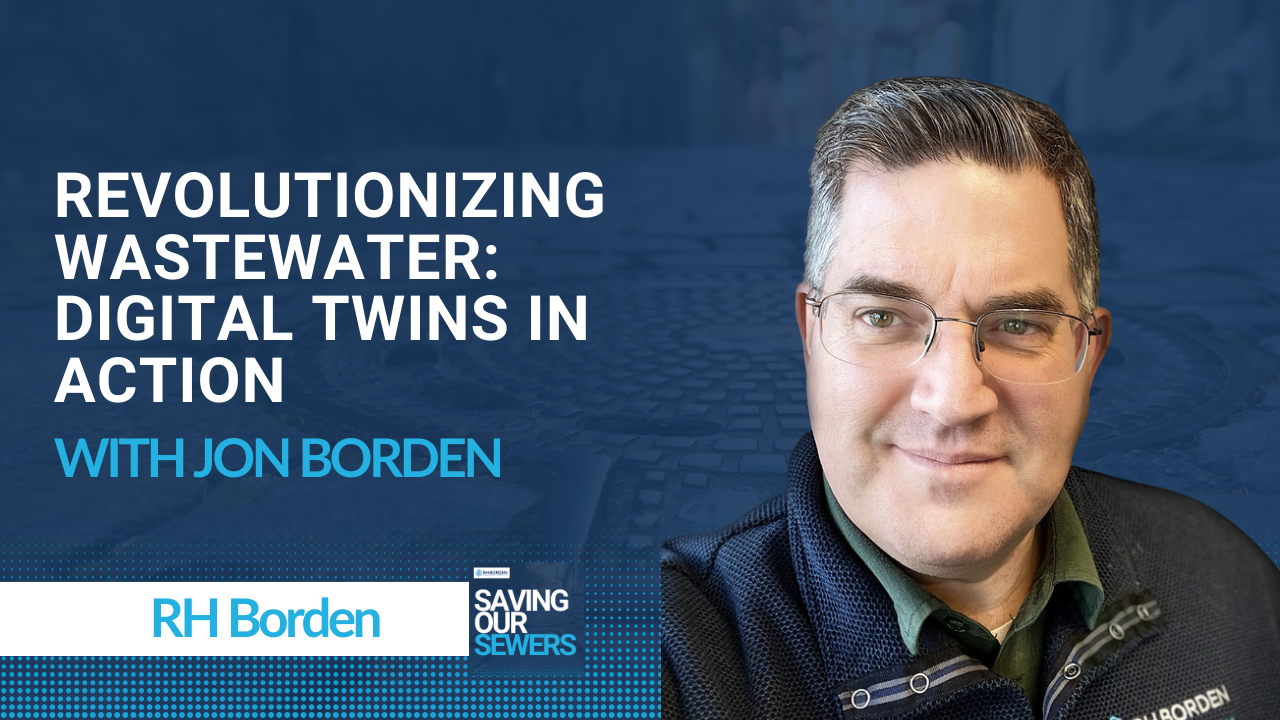
Jon Borden is the President of RH Borden and Company, a Salt Lake City-based firm applying advanced sensor technology and data-driven solutions to modernize wastewater and sewer systems across the US. Under his leadership, RH Borden pioneered digital twin and condition-based maintenance strategies, enabling cities to streamline maintenance and deliver the nation’s largest inflow and infiltration study in New York with more than 400 sensors deployed. With a background in Fortune 100 IT program management, Jon brings proven digital transformation expertise to aging infrastructure.



Here’s a glimpse of what you’ll learn:
- [1:14] Jon Borden reflects on the founding of RH Borden and his career transition into wastewater innovation
- [3:10] Why America’s sewer infrastructure earned a D+ grade and what that means for municipalities
- [5:04] Shifting from time-based maintenance to condition-based sewer management using sensors
- [7:35] How acoustic assessments and digital twins pinpoint sewer blockages and degradation
- [11:13] Overcoming municipal resistance to innovation while working within tight budgets
- [18:40] The role of AI and machine learning in detecting sewer system failures and inflow infiltration
- [21:21] Lessons from revitalizing neglected municipal systems and Jon’s vision for data-driven infrastructure leadership
In this episode…
America’s sewer infrastructure is aging, under-monitored, and expensive to maintain, often relying on outdated, time-based practices. Cities face shrinking budgets, labor shortages, and limited visibility into what’s actually failing underground. How can municipalities modernize critical wastewater systems without overspending or overhauling everything all at once?
Jon Borden says the answer starts with using data to understand actual system conditions rather than relying on schedules or assumptions. As an expert in wastewater infrastructure technology and digital systems, Jon explains how sensors, acoustics, and analytics help cities focus work where it truly matters. He encourages utilities to rethink “more work” as “smarter work,” adopt condition-based maintenance, and use data to guide long-term planning. The result is greater efficiency, lower costs, and better outcomes for communities.
In this episode of Saving Our Sewers, Jon Borden is interviewed by Chad Franzen of Rise25, as they explore data-driven innovation in wastewater infrastructure. Jon provides insights on condition-based maintenance, digital twins in sewer systems, AI-powered inspections, labor shortages in municipalities, and strategies for reducing inflow and infiltration.
Resources mentioned in this episode:
- Jon Borden on LinkedIn
- RH Borden
- Chad Franzen on LinkedIn
- Rise25
- American Society of Civil Engineers (ASCE)
- ASCE Infrastructure Report Card
Quotable Moments:
- “This infrastructure has been scored a D- by the American Society of Civil Engineers.”
- “You can save upwards of 90% of the work that’s being done if you deploy the sensors and the technology correctly.”
- “AI has incredible quantitative power when it comes to assessing infrastructure for degradation.”
- “The collection system or the sewer system historically has not really been the bastion of high technology.”
- “A paradigm shift is something that is 10 times better at half the cost.”
Action Steps:
- Shift from time-based to condition-based maintenance: This reduces unnecessary work by focusing resources only where sewer systems actually show signs of risk or failure.
- Deploy sensors to gain real-time system visibility: Continuous data helps municipalities detect blockages, degradation, and inflow issues before they become costly emergencies.
- Use data to prioritize high-risk assets: Targeting the most critical pipes and manholes improves outcomes while maximizing limited budgets and labor.
- Educate stakeholders on data-driven decision-making: Building understanding and trust makes it easier to overcome resistance to new technologies and processes.
- Leverage AI to analyze large infrastructure datasets: Advanced analytics uncover patterns humans can’t easily see, enabling faster, safer, and more accurate infrastructure management.
Sponsor for this episode…
This episode is brought to you by RH Borden, the leading service provider for innovative technologies that modernize wastewater collection system maintenance.
As Smart Cities evolve, RH Borden empowers communities to leverage data, optimize maintenance resources, and improve system performance. Their digital twin solutions help teams work more efficiently, minimize redundant maintenance, and pinpoint infrastructure issues with precision.
Learn more about how RH Borden is shaping the future of wastewater system management by visiting rhborden.com.
Powered by Rise25 Podcast Production Company
Episode Transcript:
Intro: 00:03
The US Infrastructure Report Card gives the nation’s wastewater systems a grade of D+. Welcome to the Saving Our Sewers podcast, where we feature the practices, tools, technology, and ideas that will save our sewers. Let’s get into it.
Jon Borden: 00:20
Hello everyone. Jon Borden here, host of the SOS podcast, also known as the Save Our Sewers podcast. This is where we feature city leaders, innovative engineers, and infrastructure experts who are shaping the future of our rapidly growing municipalities through smarter technology and data-driven solutions. Today, I have Chad Franzen of Rise 25. Chad has done thousands of interviews with successful entrepreneurs and businesses, and today, we have flipped the script, and he will actually be interviewing me.
So Chad, welcome to the show.
Chad Franzen: 00:55
Hey, thanks so much, Jon. It’s great to be here. Great to talk to you. I’m looking forward to finding out more about you and finding out more about RH Borden.
Just kind of tell me how you are. I mean, obviously your last name is Jon Borden. So you’re very closely affiliated with RH Borden. Just kind of tell me how your association with the company and how RH Borden came about.
Jon Borden: 01:14
You bet, you bet. So in 2018, actually, let me go back even further than that. This company was established by my dad. He is the RH in RH Borden. Robert Henry is his first to, you know, first middle name.
And he started this business back in 2005 as an independent manufacturer’s rep doing sales. And in 2018, he came across a device that was a little bit puzzling for him. It was in wastewater, and it was. He wasn’t sure what to make of it. I at the time was working in General Electric, and we were working on digital twin technologies with edge based sensors, which is just a variety of different sensors out there.
And I was working in the healthcare division and he, being my dad, showed it to me and I recognized it as what I would call a digital twin generator. And I was very familiar with that concept. And so he shared it with me. We got pretty excited about it because it was this innovative device in space. And then to make a long story short, we ended up leaving GE and we started the business together.
And so that’s why it’s got RH Borden. And that’s kind of the genesis of the whole company.
Chad Franzen: 02:27
Nice. Awesome. So just kind of tell me what RH Borden does.
Jon Borden: 02:32
So our charter and it really pivoted in 2018 where we leaned into this concept of digital twin generation and using digital twins to help our infrastructure. So this device was in wastewater. So neither of us had a tremendous amount of background in wastewater in particular. But this device is a digital twin generator. So that was the impetus of the company.
And we started to really see how we could apply that concept into wastewater and specifically into wastewater collection systems and sewer systems. And as we found out, through a lot of discovery, the collection system or the sewer system historically has not really been the bastion of high technology. And we also discovered that it’s really if you look at on a national scale, this infrastructure has been scored a D minus by the American Society of Civil Engineers. So it’s one of the worst and crumbling infrastructures in the country. And that really started to open up our eyes to the opportunities to help.
And so our charter as a company is to bring these advanced technologies into a space that is in significant need to really help leapfrog us as a country into better condition for what we feel is a very essential infrastructure.
Chad Franzen: 03:57
Sure. So you’re one of the founders. You’re the president of RH Borden. How does your role kind of help shape, shape your mission?
Jon Borden: 04:06
Well, it’s been exciting. Most of my career has been in working with Fortune 100 companies, large corporations like General Electric. Prior to this, I was leading an IT portfolio in the health care division, as I mentioned. And so moving that into more of an entrepreneurial venture, I’m taking with me a lot of that background that I, that I gleaned from those large organizations and some of the things that they’re doing. And I’m able to apply that very focused into, into the space where we are.
So it’s an exciting space to be sometimes it’s a bit petrifying. The good news is that we’re still here after going on. What is that coming up in eight years? And we’ve been able to serve the industry and learn a lot about it and really provide, I think, what’s an essential service in a, in a paradigm shift way, and to be able to to lead that as the president is super exciting.
Chad Franzen: 04:58
So you guys kind of provide data driven, condition based maintenance.
Jon Borden: 05:04
That’s right, that’s right. So it’s a new model. It is. It’s fast growing. And each year we see more people coming on board to this concept.
And what it is, it’s a pivot from historical methods of maintenance, which we categorize as time based or calendar based maintenance into more of a condition based maintenance. So the analogy that we use is, for example, changing your oil used to be that they would say change your oil every 3 to 5000 miles. Well, that’s a time based trigger where you’re waiting for you to hit the 3 to 5000 miles. It has nothing to do with the condition of your oil. It simply has to do with time.
And there’s a lot of oil changes being made unnecessarily, because the oil was perfectly fine after 3 or 5000 miles. And so they’ve put in new sensors and new ways to gauge it, that now your car will tell you when it’s time to change your oil. So we do something similar in wastewater, where historically the sewers have been cleaned and maintained on a schedule. And that introduces a lot of wasteful activity, either under cleaning a sewer system or over cleaning a sewer system simply because they don’t know when you know what’s the right trigger. So we’re using sensors to determine exactly the right time, and turns out you can save upwards of 90% of the work that’s being done if you deploy the sensors and the technology correctly.
Chad Franzen: 06:28
Interesting. So the sensors, you know, you might think like, oh, this is going to tell us all these things that we need to do. But in a lot of cases, or in apparently most cases, it tells you that maybe you’ve been doing too much.
Jon Borden: 06:39
Precisely. And almost all the cases we’re overdoing, well, we’re overdoing it all in the wrong areas. And there’s some, some areas that are just biting us because we’re not getting to them correctly. So this really exposes where the work needs to happen. We find every time this is applied, it takes less work and you get better outcomes.
And the corollary to that is in this industry also there’s a labor shortage and it’s getting worse. I think 30% of the industry is going to retire in the next five years. That’s going to and we’re not receiving in that many, you know, employees and constituents to, to to run the operation. So that’s going to put us in a real pinch if we don’t have a much more efficient way to take care of the systems.
Chad Franzen: 07:25
Tell me a little bit more about the technologies you use, like acoustic assessments or digital twin models, and maybe how they’ve been most impactful for your clients?
Jon Borden: 07:35
You bet. So we really have three offerings that we deliver as a service. We found that selling equipment to an industry that doesn’t have the staff to run it is not effective. So that’s really what gave us the inclination to create a service business. So everything we do is as a service and we deliver the data that goes along with it.
The first is acoustic assessment. This is a technology that uses sound to very quickly diagnose if a sewer pipe has a blockage in it. As you can imagine, blockages in sewer systems are not very good. You want things to just flow onto the treatment center. So, in very short order at a very low cost, we can send a team out through an entire city and determine exactly which pipes need to be cleaned.
And typically it’s only about 10% of the pipes that need to be cleaned. And most municipalities prior to this were cleaning either a third of their system unnecessarily or more or not even cleaning at all, which is, you know, the other side of the well, there are better ways to maintain it. So we go ahead of that model to determine exactly where the cleaning needs to occur, use the acoustics on that, and then we deliver that data to the city. And they take care of the system and the system improves. So that’s the first.
The second is the manholes. So I just described issues that can happen in a pipe. There’s a lot of issues that can happen inside manholes. There’s a gas called hydrogen sulfide that will degrade manholes. And manholes are key because if you’re if you can’t, if you have a collapsing manhole, that leaves a big safety problem in the city with a great big hole in the ground, that’s bad.
But also, you know, degrading manholes, let water into the system that’s known as inflow or infiltration. That extra water in the system then can take up all the capacity of the sewers. It can cause the sewers to overflow. It causes exorbitant costs at the treatment plants. In fact, the statistic is that upwards of half of the water being treated comes from inflow and infiltration, which is just unnecessary.
So if we can keep the manholes in good shape and the pipes in good shape, then that will get rid of our, you know, that’ll cut down on inflow and infiltration. So the digital twin is something where we use a high density lidar scan and a video scan of the manhole itself. And then we use AI algorithms to determine the amount of degradation that’s occurred using that point, cloud and video. And then we have a baseline view at the time of the scan. We can come in, you know, a couple years later, scan it again, compare it to where it was before.
So just like a dental exam, we can see what I would equate as cavities forming inside of the collection system of a, of a sewer system. So that’s the second offering. Third offering is again this inflow and infiltration. If I’m a public works Lead. It’s very difficult for me to identify where inflow and infiltration is coming into my system.
Again, that statistic of half of the water is from inflow and infiltration. And we now have a way using sensors to pinpoint exactly where that’s coming through. And that’s a new offering that we have that’s called basin IQ. And we just deployed that about 18 months ago. So those are the three offerings.
The third I think being the most revolutionary we can get deeper into that throughout the conversation here.
Chad Franzen: 11:13
Sure sure. So you know you guys are pretty pretty innovative. I don’t know if municipalities are prone to just embracing innovation. How do you kind of balance innovation with the realities of municipal budgets and infrastructure priorities, things like that?
Jon Borden: 11:27
Oh yeah. Well, well, the challenge that we face is a lot of education. Every time we deploy this, we typically find this to be what I describe as a paradigm shift. Now, paradigm shift is something that is ten times better at half the cost. And that’s what these technologies do.
They provide things either ten times more efficient or ten times faster. And at least half the cost or more. For example, acoustics are about a fourth of the cost. And so it’s always cost savings. But it requires the municipalities to change.
And change can be uncomfortable. So really what we focus on is first of all educating, helping people understand the value and advantage to these technologies and then helping them walk through that transition from the older way of doing things, which is that time based into the condition based world and help taking them on that journey.
Chad Franzen: 12:21
What would you say is the biggest opportunity they might have for adopting this type of digital data solutions?
Jon Borden: 12:28
Well, what we’re finding right now that we’ve found over the last, say, 12 to 18 months is kind of a pent up pain point in the industry. And that is going back to this inflow and infiltration, Inflow and infiltration is this pernicious thing. That is, it’s like a phantom. Everyone wants it to go away, but they don’t know how to find it. And now that we have Bayesian IQ, we can do something that used to take people about ten years, and we can do it in a matter of 2 or 3 months, and we can do it again at half the cost.
And it’s because we have a new type of an approach to detecting ini. And so I would say right now that’s probably our primary focus, is helping people understand that new approach, that we explain it to people. A lot of people will think, oh, I’ve been looking for that. We’ve had people tell us, you know, I’ve been looking for this for about 10 or 15 years, and now we’ve now we have it. So I and I is now a solvable thing that we can, we can go after.
And that’s probably the biggest opportunity there is.
Chad Franzen: 13:33
Do you have an example, maybe where RH Borden helped the city transition to more efficient sewer system management that may be just memorable for you or that you’re proud of.
Jon Borden: 13:42
Yes. Yes, definitely. We’ve just last year completed a landmark study in New York, the city of the District of Great Neck, New York. Like several others, we’ll focus on inflow and infiltration. I’ve been referring to.
And this, this, this city is really forward thinking. We shared with them base and IQ. And what basin IQ does in a nutshell is it uses a high density of lower cost sensors to get more granular views of where inflow and infiltration is coming from. So imagine someone lifting up a lid of a manhole and measuring the flow of water 24 over seven for five months, right? Essentially, that’s what we can do with the sensors that we have. The sensors we have can look at the flow inside of the entire collection system at every single manhole at the same time.
And when we pull all that data together and overlay rain patterns, we can say, when did rain come on top of those manholes and when did the rain get into the sewer system? Because if we follow the path of rain, it exposes ini. So anyway, that as the backdrop, we just completed the nation’s largest study of that type in New York this last year. And we deployed 423 sensors throughout the system all simultaneously. And in about three months, we identified every location of Ini in that collection system.
And the alternative would have been it would have taken them about 5 to 10 years to do what we did in that amount of time. And we not only found it from the sensors that were manholes, we had taken video of those manholes and we confirmed it with the videos we had. So that was pretty exciting to get that one out there. That’s a landmark study.
Chad Franzen: 15:35
Yeah, yeah I bet. Hey, are there any, as you deal with maybe city officials or members of the public or. I don’t know, whoever people you most frequently deal with. Are there any common misconceptions about sewer system technology that you’ve encountered?
Jon Borden: 15:50
There are. One of the biggest ones is the difficulty of implementation. Right. It comes back to change that aversion to change of like, hey, you know, if I’m just using a sensor or data, it’s much better for me to go out and actually get my hands dirty and get down pipes, get those all cleaned up. As an example, in California, we find that many of the systems are really over cleaning their systems, and they’re doing it thinking that they’re, you know, doing a great job.
And the workers are working hard, no doubt. But it’s kind of like they’re still using a typewriter approach when you can come up with a computer approach, right? And they’re just cleaning and cleaning and cleaning. And there’s actually a better way, which is sensor-based, which will alleviate a lot of that work. And they can where we have yet to take the place of an employee.
Like there is so much work out there in this infrastructure space. But the value of the work is what we can really help divert people to, to do things that are more valuable. So I think moving into the data space smart approaches is better than just the muscle.
Chad Franzen: 17:06
As you kind of discussed earlier, you had a big background before helping found the RH board and it wasn’t like, you know, you just graduated college and your dad gave you a job or something like that. You guys founded it together. You had a huge background. How was your background in data and IT management influenced the way you lead RH Borden.
Jon Borden: 17:23
Yeah, well, thanks. So I originally graduated in mechanical engineering from BYU and also certified as a PMP in project management. So that’s been most of my career. And again, over in the healthcare and medical device manufacturing and R&D and development. And that for one thing, it really helped me learn how to run a company efficiently.
I, you know, worked with several companies, saw how they were run from the inside out. I helped them develop their internal systems. So at R.H. Borden, we’ve done a lot to try and really be efficient and lean at what we do and be very, very fast. We find ourselves as a small company with that type of background. The advantages?
We can work really, really quickly. But also probably the most applicable was the last go around at GE where they were really working on the Internet of Things, the industrial internet as they called it, and digital twin technology. And that really was the background that I needed personally to conceive of what we’re doing now. And it’s exciting to be able to deploy it. And it’s yeah, it’s proving itself very successful.
Chad Franzen: 18:30
So AI is playing a role in everybody’s lives. What role do you believe it will play? AI and machine learning will play in municipal infrastructure.
Jon Borden: 18:40
Absolutely. And we’re leveraging both of those. So for example, when we scan a manhole, we let AI, we’ve written an algorithm, we validated the algorithm, and we let AI go through and determine where the degradation points are across the entirety of a manhole. Today’s standard is to have a human do that, and for a human to do that, they have to first get into the manhole, look at the wall, get out their clipboard, make a record of things. And that’s not only a dangerous thing to do, but it’s terribly inefficient.
So AI has incredible quantitative power when it comes into assessing infrastructure for degradation, and we’re leveraging it for that. The second thing that we’re using AI on right now is identifying the patterns of flow in these very large data sets that are coming through in flow analysis. As you can imagine, the study in New York, 430 423. Sensors taking a measurement every 15 minutes for several months. There’s a lot of data and marrying that up with the digital twins as well.
So all of that requires those advanced tools of AI and machine learning. And it’s exciting because that’s in the data and that, you know, these tools can now pull those insights out and really help us with our infrastructure.
Chad Franzen: 19:57
Tell me a little bit about the culture of RH Borden. And obviously you guys have to keep up with rapid technological advances. How do you guys kind of do that?
Jon Borden: 20:04
Oh yeah. Well, the number one thing that I love about this is we have been able to organize and onboard a specific type of person to our team. So we have our full team built out from our finance team to our digital team to our project managers. And the number one thing we have is we have people of incredible integrity and drive. That is so important.
To be able to make this all work is to have a real, solid person that has good, you know, integrity in the fabric. So I think our family values are key in our company and just our, our that value comes paramount. And then the competency that drives that we can drive from that is we have very competent, very well skilled people that have those ethics. And so there’s a lot of drive to make stuff happen. So we have the models of what we deploy and then the quality of person really, really not only it makes the company work, but it’s a lot of fun to work with.
Chad Franzen: 21:08
Sure. As we kind of wrap things up here, at the risk of putting you on the spot, what would you say has been maybe one of the most challenging projects you’ve overseen and maybe a primary piece of learning that you got from it?
Jon Borden: 21:21
Oh, sure. Well, right now with these three services, we feel like we can go into a municipality that maybe has not had a lot of love for a very long time, and really bring them from maybe a view of the 1950s that they’re still operating in under that, maybe they’re working off of a paper system or just tribal knowledge on what their system looks like, and we can help them leapfrog into, you know, 2026 now with with fully identified systems and all this analysis. And we’re doing that right now. And that’s very challenging because neglected systems have a lot of deficiencies. And so one case in point right now is the municipality of Silsbee, Texas.
And they’ve been so good to work with. It’s a municipality that’s had some real challenges, and they have really not had all that investment over time. And we are now helping them to deify their system entirely and apply all of our services. So they’ll have all of those insights. And it’s really exciting to see them come into that.
You know, that transparency where they can actually see their system and get to know what action to take. They don’t have to fly blind anymore. And I think we’re going to do more of that. And that’s it’s a challenge because you’re dealing with that old infrastructure. But the value you can offer, the benefit you can offer, is pretty significant in doing that.
Chad Franzen: 22:48
Okay, great. Hey, last question for you. You are going to be one of the co-hosts of this podcast, along with a few of your colleagues. What are you most excited about when it comes to, you know, talking to people on this show?
Jon Borden: 23:00
Oh, man. Well, hopefully I’ll be as good as you at interviewing. I have a lot to learn.
Chad Franzen: 23:05
No doubt about that.
Jon Borden: 23:07
But I’m excited to get a level of thought leadership going. There’s an opportunity for us to, as an industry, lean into this whole data space. When we started as a company, we would go to conferences and we were really kind of the odd duck, right? There were a lot of pump companies. There’s a lot of pipe companies.
There are a lot of hardware companies. There weren’t a whole lot of digital twin companies. And there’s been a couple that we’ve, you know, we’ve become aware of. But really as an industry, being able to create that knowledge base and that epicenter of this is where this is where data really comes from. And even bandwidth, some of our potential competitors are like this.
There’s only a few of us out there, but the whole industry can benefit. So I think I’m excited to see where that goes in the conversations we’re going to have in that space.
Chad Franzen: 23:57
Okay. Sounds good. Well, I’ll look forward to checking out some of your future episodes. Hey, it’s been great to talk to you, Jon. Thanks so much for having me today.
Jon Borden: 24:04
Hey, thanks so much, and thanks for all you’re doing. And yeah, we’re excited to make this successful and go forward in the future. Thanks so much.
Chad Franzen: 24:11
Yeah, absolutely. So long, everybody.
Outro: 24:13
Thanks for listening to the Saving Our Sewers podcast. We’ll be back next time with more insights you can use. Be sure to click and subscribe to get future episodes.